With its recent investment in Columbia China, Swire has made its first foray into the healthcare sector. Swire News talks to David Cogman, Swire Pacific's Development Director, and to Guy Bradley, Chief Executive of Swire Properties, who also chairs Swire Pacific's newly established Healthcare Advisory Board, about the thinking behind the partnership, and why the timing is right for the group to enter a new market with significant growth potential.
It's a sector where quality, operational excellence, commitment to service, brand and reputation are all very important.
A healthy outlook
Accounting for around 20% of the beds in the country's approximately 31,000 hospitals, the private healthcare sector on the Chinese mainland is growing at more than 20% per year. However, given that current healthcare spending represents only 6.5% of GDP (compared to around 10-12% of GDP in most developed nations, and as high as 17-18% of GDP in the US), the potential for growth is high.
And yet, despite its already significant size and rapid growth, it is an industry in which no clear market leaders have yet emerged. "Only a few years ago, private healthcare on the Chinese mainland basically meant healthcare services for expat and high-net-worth individuals," says David. "It's only in the last few years that we've seen the emergence of mass market, quality private healthcare, with the involvement of foreign investment." In addition, it is a sector where the Chinese government clearly sees a role for private healthcare in offering high quality, value-added services and the ability to bring in international expertise from overseas healthcare systems. "In a country which is becoming wealthier, in which GDP growth is still very strong, and where the population is ageing, this is a very attractive sector from an investment perspective."A clear focus
The group has established a Healthcare Advisory Board to oversee this new venture, chaired by Guy Bradley and including external advisors from the health sector. "Clearly we couldn't spend years studying the industry, so our outside advisors provide us with immediate access to expertise and help us to steer development of this side of the business," says Guy. "There's an obvious link between healthcare and property development and management – one of the group's core businesses. With healthcare real estate forming an expanding niche within the global real estate market, we want to explore the opportunities that exist in the market as well as the services aspect of it."
Given Swire's lack of experience in the healthcare sphere, it was crucial to find the right partner for the group's initial entry into the sector, which was what led Swire to Columbia China. Established in 2013, Columbia China is a joint venture between US healthcare provider Columbia Pacific Management ("CPM") and Singapore's Sheares Healthcare Group, which is in turn part of investment company Temasek Holdings. Specialising in developing and operating hospitals, clinics and senior housing, CPM moved into the ASEAN market with the launch of Columbia Asia in 1996, and grew to become the largest single-brand, pan-Asian private hospital company, owning and operating 28 private hospitals across India, Malaysia, Indonesia and Vietnam. Sheares is an extremely experienced healthcare investor and Temasek has a long and highly successful history of investment in China: their presence provides another layer of operational support, expertise and guidance to the management team.
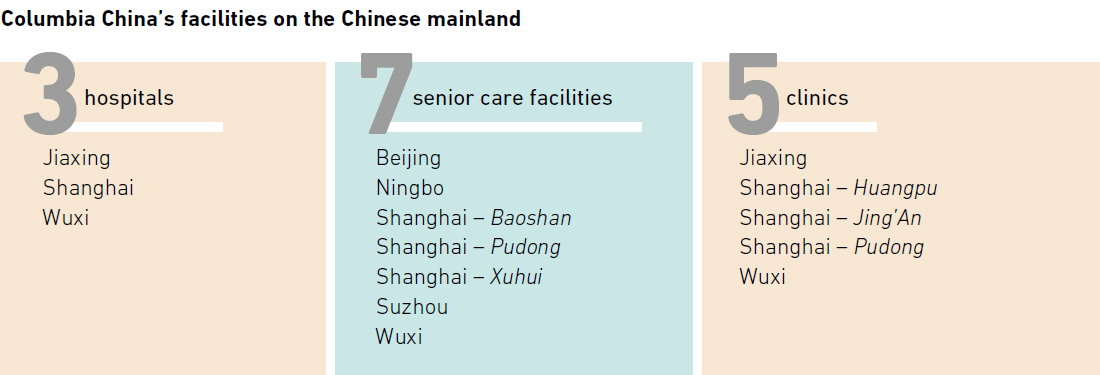
Apart from one senior care facility in Beijing, Columbia China's footprint is concentrated around the Yangtze River Delta, where it owns and operates three hospitals (one each in Shanghai and Wuxi, with a third under development in Jiaxing), five speciality or multi-speciality clinics (three in Shanghai, one each in Wuxi and Jiaxing), and six senior care facilities (two in Shanghai, and four more under development in Suzhou, Ningbo, Baoshan and Wuxi). This geographical focus was something that further piqued Swire's interest.
Future direction
When asked how she sees China's healthcare sector developing in the next five to 10 years, Ms Tan says, "China's healthcare consumer is becoming increasingly sophisticated and selective, which we believe creates an opportunity for high-quality, international-standard operators like Columbia China to set themselves apart by delivering premium healthcare services. "
Looking to the future, David Cogman says that this will by no means be Swire's only foray into healthcare. "As well as opportunities to further support Columbia's growth in the Yangtze River Delta, we are also looking for similar investments in other regions of China, for instance the Greater Bay Area, or the West – we've already got investments in Chengdu and Chongqing, where we see a lot of potential for growth. We are also looking for the right opportunities in the ASEAN region."
"The healthcare investment also marks something of a departure from the group's traditional investment strategy," concludes Guy Bradley. "In the past, our policy has typically been to secure a controlling interest in a successful business within a sector in which we already have some experience. With Columbia, we are taking a minority position in a 'new' industry that has significant potential. It's the first of several minority investments that are in the pipeline and which we hope, over time, we can build into substantial interests for the Swire group."Thinking sustainable
 Green Common offers an array of plant-based food products, making a green lifestyle more accessible.
Columbia China is not the only recent addition to the Swire portfolio. As part of its research into suitable new avenues for investment, the group looked at businesses that have a strong sustainability element. This included exploring areas such as recycling, quality of life and food supply, and ultimately led to a minority investment in Green Monday Holdings, a Hong Kong-based social enterprise that retails, distributes and produces plant-based protein. The company was founded by David Yeung, the originator of the 'Green Monday' social campaign, which he launched in 2012 to advocate for keeping at least one day of the week meat-free. Green Monday now operates across eight markets in Asia, including the Chinese mainland, Hong Kong SAR, Macao SAR, Taiwan region, Singapore, Thailand, the Philippines and Japan and is looking to expand.
 OmniPork Luncheon provides an environmentally friendly and nutritionally superior option to its pork-based counterparts.
Green Monday owns and operates plant-based grocery stores and restaurants under the Green Common brand, selling vegan food and beverage products such as Beyond Meat, Alpha Foods, Moving Mountains and Gardein, among others. There are currently 11 retail outlets in Hong Kong and over 11,000 points of sale internationally. A second business line is food tech business, OmniFoods, which has developed its proprietary product OmniPork, a plant-based alternative to ground pork. OmniPork has tapped into mainstream distribution channels ranging from five-star hotels and fine dining restaurants, to fast food outlets and supermarkets. Cathay Pacific was the first airline to offer OmniPork on its inflight menus. OmniFoods has also recently launched OmniPork Luncheon (luncheon meat) and OmniPork Strip (pork strips), as well as OmniEat, a range of ready-to-eat meals.
"Plant protein is one of the things that has to happen for us to survive as a planet, because conventional husbandry and agriculture is largely unsustainable," says Swire Pacific Development Director, David Cogman. "Interest in plant-based protein is on the increase thanks to the growing popularity of vegetarianism and veganism, especially amongst millennials - a trend that has been boosted by the new and improved meat-substitute products that have come onto the market in recent years." He adds that unlike the 'fake meat' of the past, this new generation of plant-based protein products is more sophisticated and, crucially, has a much more positive image among consumers. "We are very excited about the partnership with Green Monday and look forward to further collaboration with them across our group companies, with the ultimate goal of promoting sustainable and healthy living".