HAECO Xiamen has unveiled plans to relocate its entire operations to a state-of-the-art facility at Xiamen's new Xiang'an International Airport, due to open in late 2023. The new facility, which will represent the largest single gross investment the HAECO Group has ever made, will dramatically transform the company's operations. It will also reaffirm HAECO's commitment to investing in Mainland China and contributing to the development of the region's burgeoning aviation industry. Swire News talks to Summit Chan, HAECO's Group Director Corporate Development and Chairman of HAECO Xiamen, to learn more about the significance of this new investment.
Biggest one-time gross investment
HAECO established a subsidiary at Xiamen in 1993, and began operations in 1996. Originally known as TAECO (Taikoo (Xiamen) Aircraft Engineering Company), the company rapidly developed from a modest aircraft Maintenance Repair & Overhaul (MRO) service provider into a comprehensive provider of aircraft engineering and maintenance solutions, servicing airlines from around the world.
"I believe the original plan in 1993 was to build two hangars at Xiamen's Gaoqi International Airport, but between 1996 and 2011, HAECO eventually built six hangars as a result of organic growth," explains Summit Chan.
HAECO Xiamen now boasts a portfolio of airframe services, including aircraft maintenance, structural and cabin modifications, passenger-to-freighter conversions, and line services at 13 airports across Mainland China. It offers cabin completion services for private jets, and also operates its own certified build-to-print aircraft parts manufacturing facility, as well as a large technical training and examination centre.
The company's success laid the foundation for a cluster of aviation services businesses. In 2008, the HAECO Group undertook a major diversification into adjacent businesses, opening a GE engine overhaul shop and a landing gear shop at Xiamen; this was followed by a composite shop in nearby Jinjiang, the following year. These investments turned HAECO into the biggest aviation industry service provider in these cities.
Moving towards greater efficiency and sustainability
HAECO Xiamen's technical capabilities at Gaoqi developed organically: from initially focusing on servicing Boeing 737s and 747s, the company now has capability to handle practically any aircraft type and engine configuration from the Boeing and Airbus families. Starting ‘from scratch' at Xiang'an presents HAECO with the chance to plan a new facility that is specifically designed to offer flexibility and efficiency in dealing with the complexity and diseconomy of scope that is a factor of serving multiple fleet types for customers around the world.
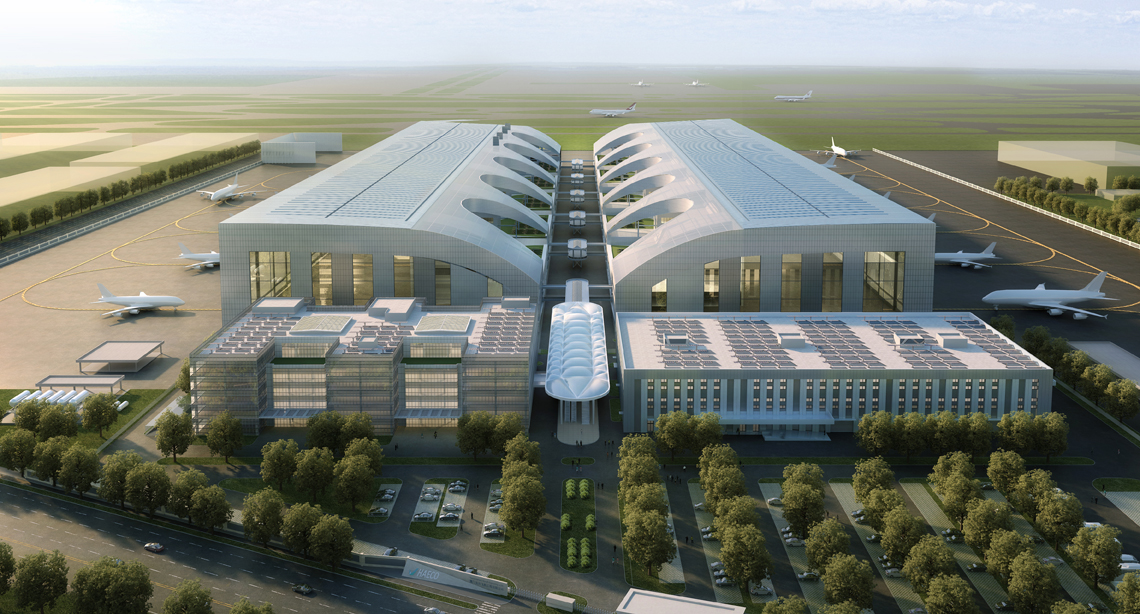
The new hangar will include 12 wide-body inner bays, two of which will be equipped for segregated aircraft painting, and six narrow-body mid-bays, offering a similar footprint and capacity to the existing facility at Gaoqi. The new hangar will feature back-to-back, nose-in bays, a central-spine design to facilitate logistics and resource sharing, and a twin taxiway to allow for the efficient movement of aircraft. These features will help to shorten turnaround times and give better on-time performance, providing better value for customers. The free-standing hangar structure – will boast one of the longest spans in the world – will maximise space available to house the wide range of aircraft types it will handle, thereby offering greater flexibility to cater to customers' maintenance schedules.
"At the new airport, our staff can look forward to working in a state-of-the-art hangar facility that incorporates advanced technology and environmentally-friendly features", says Summit. An array of features have been integrated into the facility's design to optimise energy efficiency and minimise carbon emissions. Solar panels will be installed on buildings with flat roofs, and solar films on hangar roofs are being evaluated; together, they could generate up to 30% of the facility's power consumption. Other features include a smart Building Management System, intelligent lighting control and a chilled-water air conditioning system, as well as facilities for the on-site treatment of waste water, gas and volatile organic compounds. The facility aims to attain Gold LEED certification.
Better services for airline customers
HAECO Xiamen is also trialling a range of initiatives that will utilise advanced technology. One example is the use of data analytics. Mr Chan elaborates: "When we rectify maintenance issues, a lot of useful data about the aircraft is generated. Data analytics can allow customers to anticipate maintenance issues to better inform their fleet maintenance planning."
Another initiative is the use of drones fitted with high-definition cameras to enhance the accuracy and efficiency of aircraft inspections. Equipped with geo-fences and anti-collision sensors, drones are already being used to carry out post-maintenance checks. In addition, augmented reality smart glasses will enable HAECO's engineers to access technical data remotely and to communicate more effectively, while automated guided vehicles and smart lockers will form part of a new digital warehouse and logistics infrastructure. Over the long term, these technology-assisted operational initiatives will help the company become more competitive and will add value for airline customers.
And HAECO Xiamen is looking even further ahead: "In the future, when the technology is more mature, artificial intelligence will probably help our engineers analyse defects – not just record them", enthuses Summit. "We are also looking at robotic painting of aircraft parts. With the new facility, we will be able to integrate the hangar design with these technologies, and they will be enablers for improved performance standards and reduced aircraft maintenance ground times, which will benefit our customers."
The company continuously reviews its operations to improve safety and quality, and be best-in-class in terms of operational efficiency; Centres of Excellence are recognised for lean processes and these elements are top-of-mind in planning for the new facility. HAECO Xiamen's frontline staff are trained by Japanese instructors and encouraged to brainstorm and develop their own ideas for operational improvements under a Quality Control Circle programme. An end-to-end process optimisation project has recently been completed to lay the foundation for a new Enterprise Resource Planning (ERP) system to be in place prior to the move to the new facility.
While moving to the new airport presents a once-in-a-lifetime opportunity to build in optimisation and hardware, Mr Chan notes that moving a big set of operational activities is always going to be hugely challenging. "It takes a lot of planning to make sure that it will transition well. Once the local government approves the preliminary designs for the new facility, the design firm's architects and engineers need to produce construction drawings – and at present we are looking at around 3,500 of them. Then there is the tendering process for contractors and suppliers, and project management of the construction itself. And when construction has been completed, the facilities will need to undergo audits by various regulatory authorities from around the world. This is the process we are managing from now until the target completion date at the end of 2023," he says.