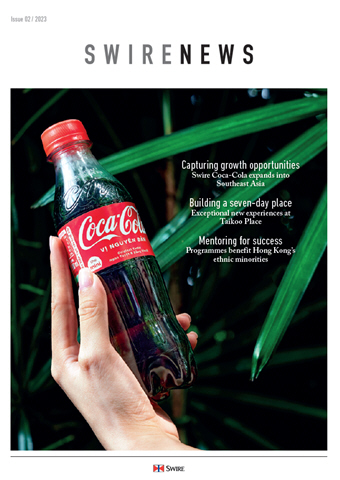
Through its recent acquisitions of Coca-Cola Beverages Vietnam and the Cambodia Beverage Company, Swire Coca-Cola (“SCC”) has reached a major milestone by establishing a strong presence in Southeast Asia.
SCC has a remarkable history of growth, making it the fifth largest bottling partner of The Coca-Cola Company by global volume and revenue today. It manufactures, markets and distributes a diverse range of iconic brands across a large swathe of franchise territories in the United States and Greater China. For SCC, momentum is continuing to build on this fascinating journey.
Late last year, it was announced that SCC was to acquire Coca-Cola bottling businesses in Vietnam and Cambodia, marking the company’s first foray into Southeast Asia and a clear confirmation of intent about expanding the business. Taken together, the acquisitions have grown SCC’s franchise population across all the regions where it operates to 882 million people – an increase of 15%. It is expected that Vietnam alone, with its three beverage production facilities, 18 production lines and six distribution centres, will grow SCC’s revenue by over US$490 million and 150 million unit cases each year.
Now that the acquisitions are complete, SCC is ready to bring all its 58 years of experience and expertise to bear on driving portfolio growth within this dynamic and exciting third operating region.
We already operate in Greater China and the western US. Adding a third region creates even more prospects for growth.
Strong credentials and expertise
For Karen So, SCC’s Managing Director, the move into Southeast Asia is a crowning achievement, as well as a long-awaited opportunity to expand the business.
“Our people have accumulated so much expertise and knowledge over decades,” says Karen. “We are also leaning on The Coca-Cola Company’s very robust system, as well as the world’s number-one beverage brands.”
“We have shown The Coca-Cola Company that we operate very successfully in our markets in Greater China and the USA, and we possess both the readiness and ambition for growth. They see us as a very strong, long-term partner, which is why this opportunity came to us. It is the first time our business has branched out of its legacy territories and into Southeast Asia, and we are going to demonstrate that we can operate in these new countries extremely well,” she adds.
The expansion is a strategic move to diversify and balance the company’s overall portfolio, as Karen explains: “We already operate in Greater China and the western US. By adding a third region, we gain even more prospects for growth.”
As two fast-growing markets, Cambodia and Vietnam present ample opportunities. “In terms of demographics,” says Karen, “these markets have young populations, who tend to be more active and enjoy sparkling drinks. The current per capita consumption of Coca-Cola beverages is 36 units in Vietnam and 44 in Cambodia, which is very low compared with other markets, such as Hong Kong, where it is 192 hence the immense potential we can unlock.” In terms of market share, while SCC is already the market leader in non-alcoholic ready-to-drink (“NARTD”) beverages in Cambodia, in Vietnam the company is placed third, which provides an opportunity to grow and rise through the ranks.
World-class efficiency
In any fast-moving consumer goods (“FMCG”) business, efficiency is key to success. SCC achieves top-notch efficiency through advanced digitalisation and automation. Hunter Jin, CEO, South East Asia, Hong Kong and Taiwan Operations at SCC, sheds light on how: “The Coca-Cola Company’s global bottling system is the most extensive soft drinks distribution system in the world. The exact system and formula might vary a little across different markets, but they ensure both The Coca-Cola Company and bottlers are aligned to work together to drive value. We have invested in building a world-class bottling system. Our successful experience in operating the diverse markets of Greater China and the US will help us capture opportunities in these dynamic Southeast Asian markets.”
With over 30 years of experience operating on the Chinese Mainland, SCC has developed key capabilities in route-to-market expansion in various communities, both urban and rural. A key characteristic shared by Cambodia and Vietnam is that a large proportion of each country’s population is rural and decentralised, which can be challenging. Yet the knowledge of how to devise a compelling proposition and to operate effectively in rural communities is a hallmark of SCC.
“Although the Vietnam and Cambodia markets are different in nature to the Chinese Mainland – and we have much to learn from our new colleagues – we can certainly leverage our rural expansion strategies, as well as our granular approach to urban route-to-market strategies, and apply this experience to these two countries,” says Hunter.
Even the company’s approach to consumer engagement is led by efficiency. For direct consumers, there is an opportunity to convert traditional under-the-cap promotions into more interactive and engaging electronic formats by deploying the digital solutions that have proved successful in SCC’s other markets.
“Our consumers can scan a QR code, play a game and win a free Coke, then redeem it at a nearby store. To young, fun-loving consumers, the instant gratification of the prize is very important,” says Karen.Sparkling beverages are currently our bread and butter, but we are keen to diversify and expand our categories, particularly into the energy category.
Catering for local tastes
Portfolio expansion is a key pillar of SCC’s regional commercial strategy. The company takes a deliberate approach, investing consistently over a number of years together with its brand partners in categories where it has a competitive edge. “We work closely with our brand partners to put local consumers and their needs at the centre,” says Hunter, “which will help us win in both Vietnam and Cambodia. We have confidence in our brand partners that they will develop and market products that cater for local consumer tastes, which is a prerequisite for success.”
Karen describes the need to increase SCC’s market share in its newest operating region: “Sparkling beverages are currently our bread and butter so to speak, but we are keen to diversify and expand our categories, particularly into the energy category where we have a few strong competitors.” Presently, in both countries, energy drinks form the biggest category. Current tastes favour these highly sweetened drinks, which are often sold by roadside vendors over ice. This dilutes and chills these types of beverage, making them suited to the hot climate.
Charting the course
With any acquisition, SCC enacts time-tested protocols, such as analysing existing operations before making any changes. And there will be wider market challenges to overcome, particularly when entering a completely new region.
Karen considers this situation to be a huge opportunity for growing market share. “It means deciding what portfolios we need, as well as our route-to-market strategy. We will establish what our current capability is and what our people need to succeed. While we work on these, we also need to develop a 2030 vision for each country, which will contain our targets for growth and market share, as well as cases per capita. We need to be there and make sure we have a winning proposition and to invest well ahead of consumer trends to make sure we can capture that space,” she says.
To realise these ambitious goals, talent capability is key. SCC is deploying a mix of the best worldwide talent to grow these new markets. Hunter himself has a wealth of experience in the Chinese Mainland and US market; in his team the Chief Commercial Officer is from SCC’s China team and there are also experienced individuals from the US who run key accounts. Furthermore, the company has hired people from other global bottling groups.
But it isn’t just talent from within SCC and the companies it has acquired that will lead to success. SCC is also striving to win together with the communities where it operates and the wider environment, particularly around managing the impact and the footprint of single-use beverage packaging. “Currently we are collaborating with local communities on a plastic collection system, particularly targeting rivers, and are looking into sponsoring a number of large-scale environmental initiatives in future. Fundamentally we want to develop a closed-loop cycle for plastic bottles,” Karen says.
Ultimately, all the key ingredients for market share growth are already in place. Karen sums up: “By leveraging our proven strengths in our commercial capabilities, marketing, supply chain, customer service and digitalisation in our existing operating regions, combined with the strength and local expertise of our new colleagues, we will be able to continue serving the needs of our customers and consumers in Cambodia and Vietnam effectively and contribute positively to local communities.” It sounds very much like a formula for success.