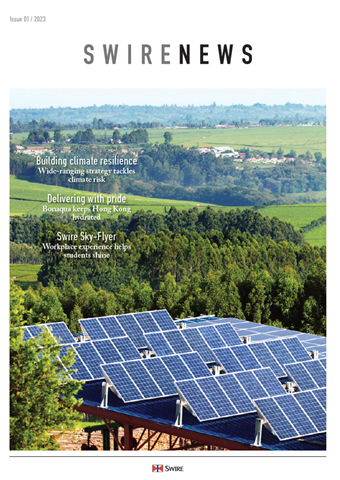
While climate change poses an existential threat to humanity in the longer-term, global economies and businesses will face their most acute challenges over the next decade, according to a World Economic Forum report published earlier this year. Swire is implementing radical measures to ensure its global operations are resilient to the impacts of climate change.
As companies and financial institutions come to terms with the fact their very survival will be determined by their exposure to current and future climate-related risk, they also face mounting regulatory, stakeholder and societal pressure to assess, disclose and mitigate their vulnerability.
Like many multinationals determined to “do the right thing”, Swire has an ambitious programme for decarbonising its portfolio. But this is just one part of a much wider strategy to ensure that the Group is resilient to the impacts of climate change across all its diverse operating companies and geographical markets. “Swire is a 200-year-old company and we have had to adapt to a changing operating environment many times over that history,” says Swire Pacific’s Group Head of Sustainability, Mark Harper, based in Hong Kong. “Climate change is the next challenge and arguably one of the most difficult the business has faced.”
What we do now will help to determine whether we can prevent the worst consequences of climate change. We must act!
Understanding the risks
Subathra Vaidhiyanathan, Group Head of Sustainable Development, John Swire & Sons, based in London, explains that both “physical” risk (droughts, flooding, extreme weather events, etc.) and shorter-term “transitional” risk (associated with changing strategies, policies, or investments to effect rapid decarbonisation) already impact on various aspects of the Group’s global business activities and inform Swire’s overall strategy and response to climate change. “The big question is how do we ensure that Swire remains a functional business across multiple sectors in many regions, in the face of the worst effects of climate change?” she says.
“To manage risk, you must first understand risk,” says Mark, “so conducting a climate risk assessment is vital for any climate resilience programme.” He explains that Swire Pacific has already assessed the physical risk to more than 850 of its most valuable assets (by insured value), using the S&P Climanomics analytics platform to model climate risk for each asset out to the year 2100.
Swire Pacific is also “walking the talk” on its science-based decarbonisation targets. “Lots of companies talk about achieving net-zero by 2050,” says Mark. “However, we have also set very aggressive decarbonisation targets to achieve a 50% reduction in CO2 emissions by 2030 across all businesses where we have operational control.” As part of this strategy, the Group will be testing an internal carbon price methodology this year. This scheme will involve applying a fee to all carbon generated by our operations, with the proceeds being used to fund ongoing decarbonisation efforts. This will strengthen efforts to decarbonise and help build climate resilience into future investment decisions.
So how does Swire develop a policy that works for a spectrum of businesses as diverse as tea and shipping – all of which confront subtly different types of climate risk? Says Subathra: “We employ strategic thinking around systemic problems. We look at key sustainability issues and how they manifest in each operating company, the different sectors, and geographies in which they operate. This Group-wide framework of ambitions, guidance and policies are then used by each individual Swire company as the basis for developing practical and innovative mitigation strategies accounting for the diversity of sectors and locations.”
Swire Properties: innovative landscape engineering
Swire Properties is recognised for its SD 2030 Strategy and its pledge to meet targets aligned with the Business Ambition for 1.5°C. For individual development projects, the team is also implementing tailormade climate-proofing measures.
In Miami, Florida, a flood-prone coastal city, Swire Properties is partnering with Miami-Dade County authorities to develop a long-term flood defence system, using nature-based protections against storm surges and sea-level rise. These include a series of barriers to dissipate wave energy, using a combination of submerged oyster reefs and earthen levees.
A slightly different approach was applied to Savyavasa, a luxury residential development in low-lying Jakarta, Indonesia, due for completion in 2024. Here, green landscaping is being used to create giant natural sponges that will absorb stormwater.Swire Coca-Cola: safeguarding the essential ingredient
The ready availability of clean fresh water is essential to Swire Coca-Cola, so understanding the impact of physical climate risk on its bottling plants and ensuring a sustainable, long-term water supply is top priority. “A comprehensive water risk assessment considers not just Swire Coca-Cola’s needs, but also the projected demands from other users in the area, as well as water quality and availability,” says Mark.
Swire Coca-Cola has developed a Source Vulnerability Assessment programme to assess production water supply reliability for all its plants. The bottler also collaborates with The Coca-Cola Company on water replenishment projects on the Chinese Mainland and in the US, with the goal of returning a litre of clean water to natural water systems for every litre of water used in its beverages.
Cathay Pacific: committed to sustainable fuel
Cathay Pacific is slightly less vulnerable to the physical risks of extreme weather and more exposed to transitional risks, often contingent on regulatory change. For example, future imposition of a carbon tax on aviation fuel could result in a massive additional cost burden.
Cathay Pacific has committed to achieving net-zero carbon emissions by 2050 – one of the first Asian airlines to set this target. To achieve this objective, Cathay is pioneering the use of Sustainable Aviation Fuel (“SAF”). The airline has pledged that by 2030, SAF will account for 10% of its fuel usage. That may not seem much, but when you consider that the current global supply of SAF is less than 0.05% of total EU aviation use, the target starts to sound a lot more ambitious. And Cathay is also addressing the supply issue: in 2014, the airline invested in Fulcrum Bioenergy Inc. – a US company that produces SAF from municipal waste. “Cathay has also been engaging in talks with other potential users and government on the Chinese Mainland and elsewhere, to promote the development of SAF infrastructure and opportunities,” says Mark.Swire Shipping: driving sustainability at an industry level
Swire Shipping is one operating company for which the threat from both physical and transitional climate risk is immediately apparent – on the one hand from potential loss of its core Pacific Islands markets to sea-level rise, and on the other from regulatory targets around decarbonisation.
Swire Shipping is committed to the International Maritime Organisation’s 2018 greenhouse gas (“GHG”) reduction strategy, which aims to reduce GHG emissions from shipping by at least 50% by 2050. The company is a strategic partner in the Mærsk Mc-Kinney Møller Center for Zero Carbon Shipping and has appointed its first secondee to work on “green corridors” for shipping. It is also exploring the possibility of building dual-fuel vessels for the Pacific-New Zealand coastal trade. Meanwhile, Swire Bulk is undertaking a pilot project with the Global Centre for Maritime Decarbonisation to trial thirdgeneration algae biofuel, which has a negative production footprint.
Swire Shipping is forging sustainability partnerships with local island communities, including a waste management project and mangrove restoration. “The challenges faced by the Pacific Islands are deeply felt by Swire Shipping employees, many of whom have been a part of these communities,” says Subathra. “This is one of the reasons for our ambition to be early movers on alternative fuels.”Global climate-proofing
By adopting a proactive, long-term strategic approach, Swire is ensuring it accurately assesses and manages climate resilience across its diverse operating environments. Robust mitigation of both physical and transition risk is married with hard-hitting, science-based decarbonisation targets, as part of the Group’s overall sustainability commitment. And, says Mark, on the flip side of risk, real opportunities can arise as companies seek the best solutions for transitioning to a zero-carbon economy, in terms of development of new products and services. Crucially, however, the Group’s motivation extends beyond short-term ESG obligations, potential risk to reputation, or even the need to deliver long-term returns for shareholders, and is embedded as a core value at the heart of Swire’s businesses: the aim is to excel as a global corporate citizen.
“What we do now will help to determine whether we can prevent the worst consequences of climate change,”concludes Subathra: “Swire’s motto, ‘To be, rather than to seem to be’, speaks to the heart of the challenge we face. We must act!”